Discover ways of helping kids connect with what they learn in social studies for meaningful engagement and retention.
Helping Kids Connect With What They Learn in Social Studies
Many kids treat social studies like a pile of names, dates, and worksheets. And because of that, they don’t care. And yet, in 2026, social studies is arguably more important than ever before.
The good news is simple, parents and teachers can make the elementary social studies curriculum feel personal, active, and useful.
Start With the World Kids Already Know
Connection comes before recall. If a lesson starts with a child’s own life, the content has something to stick to.
Recent guidance from groups like Edutopia, Teaching Strategies, and RAND points in the same direction. Kids connect more when social studies begins close to home, then expands outward. That means home, school, neighborhood, town, and then the wider world.
Use Family Stories, Daily Routines, and Local Places as Entry Points
A child’s life is full of social studies already. You don’t need a museum trip to prove it.
Family stories work well because they make history feel human. Ask kids to interview a parent or grandparent about a move, a job, a tradition, or a favorite childhood place. Suddenly, topics like immigration, work, community change, and culture stop being abstract.
Daily routines also help. A simple schedule can teach past, present, and future. “What did we do yesterday?” becomes a history question. “What happens after lunch?” becomes a sequence question. Time is no longer a chart on the wall. It’s part of their day.
Then look outside. A walk to the park can teach geography. A trip past the post office, library, or bus stop can spark talk about community helpers and public services. Even noticing a hill, river, or busy street builds map sense.
Social studies is not only about the distant past. It explains the world kids move through every day.
Ask Simple Questions That Help Kids Make Personal Connections
Good questions open the door. Better yet, they don’t demand one perfect answer.
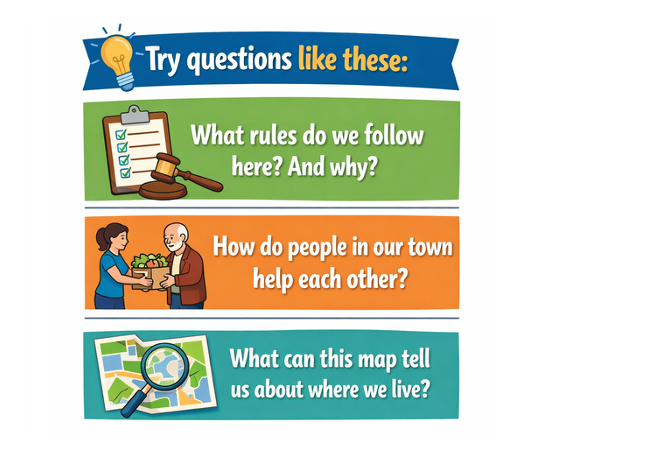
These questions get kids to think critically. They tell kids their ideas matter.
That matters because curiosity beats memorizing every time. When a child compares home rules to school rules, they’re learning civics. When they notice which stores are near their block, they’re learning economics and geography. When they ask why an old building still stands, they’re stepping into history.
Make Social Studies Active Instead of Just Something Kids Read About
Reading has a place, of course. Still, younger learners often need to touch, move, sort, build, and act things out before ideas click.
That’s why hands-on social studies keeps showing up in recent best-practice advice and updated standards. Some state revisions, including recent Texas standards updates, place more weight on inquiry and applied skills, not only recall.
Bring Lessons to Life With Maps, Artifacts, Photos, and Pretend Play
Concrete materials help because they give kids something to notice and talk about.
Digital tools can help too, as long as they stay simple. Short videos, virtual museum tours, and educational websites can give kids another way to explore places, people, and events.
Old photos are another strong example. Show a picture from years ago and ask, “What do you notice first?” Then ask, “What do you think was different then?” Kids love making careful guesses. It trains observation and builds historical thinking without turning the lesson into a quiz.
Objects work the same way. Put out an everyday item, or an older one if you have it, and let kids ask yes or no questions. Who used it? What was it for? Where might it belong? That simple game teaches inquiry.
Maps also become easier when kids make their own. Let them draw the classroom, playground, or their route home. Add labels, symbols, and landmarks. For many kids, a map stops being a puzzle once it describes a place they know.
Pretend play is another winner. A store or restaurant setup can teach goods, services, jobs, prices, and rules. Play money helps. So does assigning roles.
Help Kids Think, Talk, and Care About What They Learn
Activities get attention. Discussion gives them meaning.
Use Discussion and Inquiry to Move Beyond Memorizing Facts
Short, regular discussion beats one big speech.
Classroom meetings, partner talks, and brief current event chats all help. A child doesn’t need a college seminar. They need space to wonder out loud and hear another view.
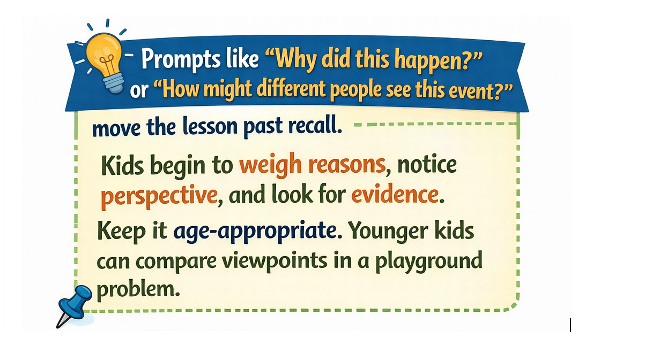
Older elementary students can discuss a local issue, a school rule, or a news story. The goal is simple, listen well, speak with care, and back ideas with facts.
Tie Every Lesson Back to Real Life So Learning Sticks
Real-life links are what make the subject stay put.
A unit on government can connect to school rules, class votes, or a student council election. A lesson on geography can link to weather, local landforms, or how people use parks and roads. Economics can show up in lunch choices, saving money, or the jobs people do in town.
Current events also help, if you keep them short and clear. Trusted educational websites can also help explain a topic in a way that feels clear and manageable for kids.
Kids don’t need a flood of headlines. They need one manageable topic and a calm adult nearby.
Leave A Reply!