Learn how to add daily brain activation exercises for kids into playtime to enhance focus and emotional regulation.
How to Add Daily Brain Activation Exercises for Kids into Playtime
If your evenings tend to swing between meltdowns, screen battles, and that 6 p.m. spiral where homework still isn’t done, you are not parenting wrong. You are parenting a child whose prefrontal cortex – the part of the brain that runs focus, impulse control, and emotional regulation – is still very much under construction.
Those exact skills are buildable. Researchers call them executive functions, and a growing part of studies in developmental neuroscience show that short, playful, intentional activities can strengthen them in measurable ways. An intervention study in Frontiers in Psychology on how to promote executive function skills in children using a play-based program found that preschoolers who did just 10 simple, fun games over a few weeks made gains in executive function, language, and motor skills. A separate clinical trial out of the Niilo Mäki Institute reached a similar conclusion using a play-based program of ball games, puzzles, and Simon-says-style activities.
So you don’t need flashcards, a tutor, or yet another game app your child will get glued to. You need a short, structured practice your child does off the screen – a few minutes a day, woven into the playtime that is already happening.
Here is how to do that without adding one more thing to your plate.
What “Brain Activation” Actually Means
Brain activation exercises for kids are short, deliberate movements and games that engage the parts of the brain responsible for attention, self-regulation, and learning. Most of them share a few features: they cross the body’s midline, they require a child to follow a rule or pattern, and they end before a child gets bored.
Cross-lateral movements – anything that asks the right side of the body to work with the left side, like touching the right hand to the left knee – engage both hemispheres of the brain at once. Occupational therapists use them to support the corpus callosum, the bundle of nerves connecting the two halves of the brain, and some researchers suggest that coordinated bilateral activities may help facilitate communication between the cerebellum and prefrontal cortex, the region that handles focus and impulse control.
A silly game of “touch your opposite elbow to your opposite knee, five times, faster each time” is not just burning energy before bed. It is supporting the wiring that helps your kid sit still for circle time tomorrow.
Anchor Brain Activation to Playtime You Already Do
The mistake most parents make is treating these exercises like a separate “session” that requires special equipment, a quiet room, or a child who is, miraculously, in the mood. That is not how childhood works. The trick is to attach short brain-activation moments to play that is already happening.
A few examples that take less than five minutes:
During morning chaos. Before shoes go on, do 10 cross-crawl steps in the hallway – opposite hand taps opposite knee, marching in place. Make it a race against a song. This wakes up the body, supports bilateral coordination, and gives your child a tiny success before the school run.
While building with blocks or LEGO. Play “Builder Says.” You call out the next piece, the color, and where it goes (“Builder says: put a red 2×4 on top of a blue 2×4”). This trains a working memory – one of the three core executive functions identified across the research literature, alongside inhibitory control and cognitive flexibility. The harder you make the instruction, the more your child’s brain has to hold and process.
In the car. Try “Opposite Day.” When you say “go,” they say “stop.” When you say “up,” they say “down.” This is inhibitory control training disguised as a giggling fit, and it is exactly the kind of game shown in classroom research to support self-regulation.
During pretend play. Dramatic play already builds executive function – children have to remember roles, follow self-imposed rules, and adapt to what their play partner does. You don’t have to direct it; you just have to protect the time for it. 20 minutes of uninterrupted “let’s pretend we’re running a restaurant” is doing more cognitive work than it looks like.
Outside. Hopscotch, climbing, and skipping are all reciprocal bilateral movements. So is riding a scooter. Skip the apps and let the playground do the heavy lifting.
The Two Rules That Make This Stick
After watching this play out with families, two principles separate the parents who see real change from the ones who give up after a week.
Rule #1: Short and daily beats long and occasional
A 30-minute brain-training session you do twice a month does almost nothing. 5 minutes a day for 6 weeks rewires habits in both your child and you. Consistency is the active ingredient – the same finding shows up in every play-based executive function study cited above.
Rule #2: Do, do not lecture
Kids do not need to understand neuroscience for it to work on them. Resist the urge to explain why you are doing the cross-crawl. Just do the cross-crawl. The brain does not require informed consent.
When a Small Structure Helps
For parents who do better with a plan than with “try to remember to do this,” a guided routine can be the difference between an idea you read once and a habit your family actually keeps. That is the gap theleaply app may help to close – short, structured practices personalized to your child, 1 per day, so you don’t have to invent the activity, gauge the right difficulty, or remember what you did yesterday.
The customized plan focuses on daily brain activation exercises for kids designed to support focus, emotional regulation, and easier transitions – exactly the areas executive function research keeps pointing to.
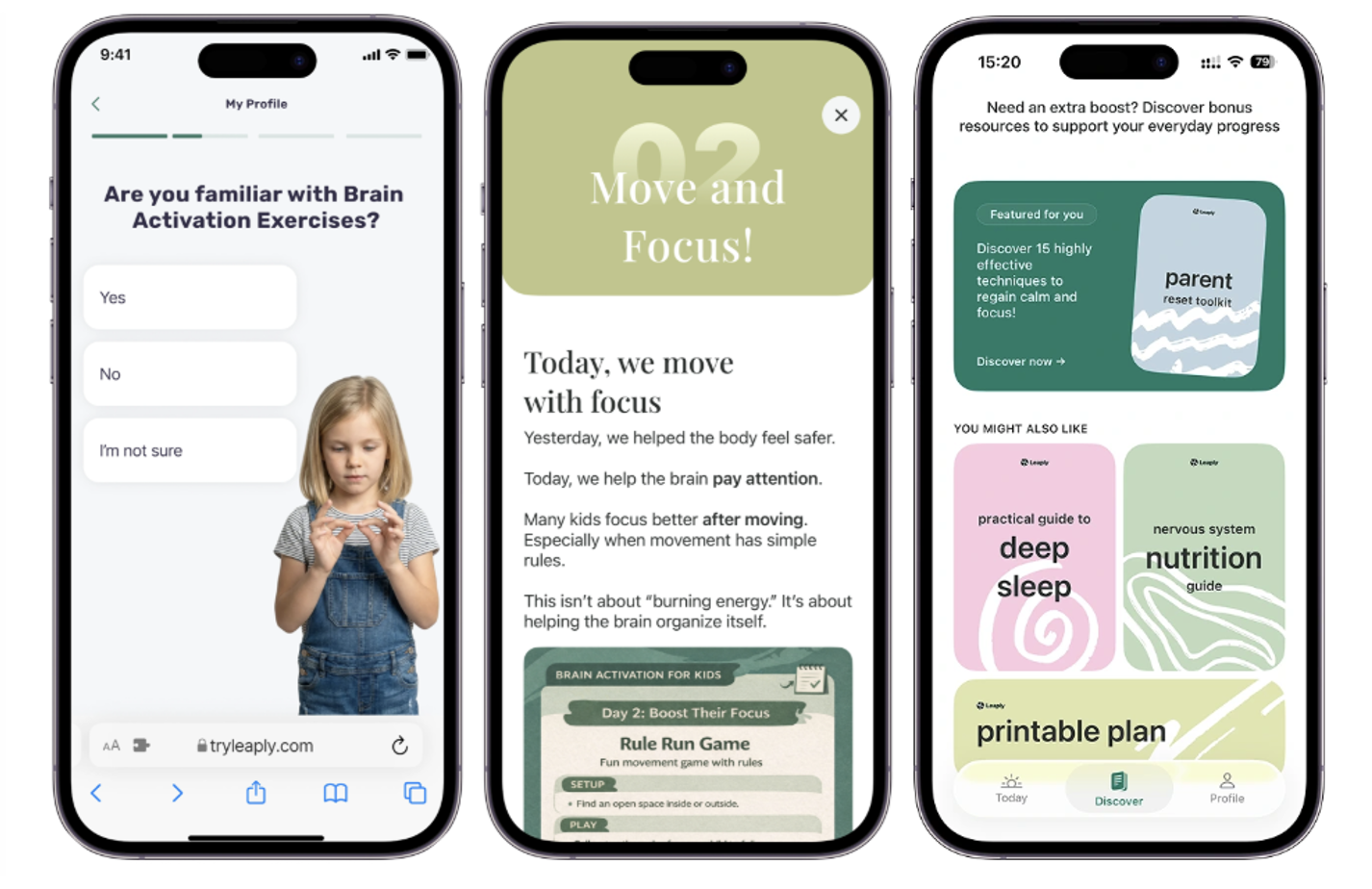
You can do this with a printed list on the fridge, too. The point is not the format. The point is having 1 small, defined action you do every day instead of a vague intention.
What to Actually Expect
You will not see a different child after one week. What you may notice, somewhere around weeks three to six, is that the gap between request and response gets a little shorter. The post-school meltdown gets a little less intense. Transitions get a little smoother. Your child sits with a puzzle for a few more minutes than they used to. These are small shifts, but they compound – and compounding is the entire game.
You will also probably notice something in yourself: less yelling, fewer power struggles, more shared laughter during the day. That is not nothing. That is the quiet, real version of what “brain activation” looks like in a family.
5 minutes. Cross the midline. Make it a game. And if you want one ready for you each day – without having to think it up yourself – let Leaply hand it to you. That is the whole secret.
Leave A Reply!