Explore beyond the HEPA filter and learn how to detoxify your home’s air for a healthier environment for your children.
Beyond the HEPA Filter: A Parent’s Guide to Detoxifying Your Home’s Air
The Hidden Truth About Your Home’s Air Quality
As parents, we go to great lengths to baby-proof our homes, yet we often overlook the invisible threats floating right in front of us. Modern energy-efficient homes are built to be remarkably airtight, which is fantastic for lowering heating and cooling bills. However, this lack of natural draft creates an unintended trap for airborne pollutants.
Everyday items like synthetic carpets, multi-surface cleaning sprays, and newly unboxed furniture constantly off-gas Volatile Organic Compounds (VOCs) into your living space. Common culprits include formaldehyde, benzene, and toluene, which invisibly seep into the rooms where our children play and sleep.
Without a clear escape route, these chemicals, along with trapped humidity and mold spores, build up to concerning concentrations. For young children whose lungs and immune systems are still rapidly developing, this invisible indoor smog can be a constant source of respiratory irritation and allergic reactions.
Next-Level Air Filtration: Moving Beyond Basic Filters
When trying to clear the air, most parents immediately purchase a standard air purifier, assuming it will solve the indoor pollution problem entirely. While deploying a purifier is a fantastic first step, understanding how these devices actually work is crucial for true home detoxification.
Why Standard HEPA Isn’t Always Enough
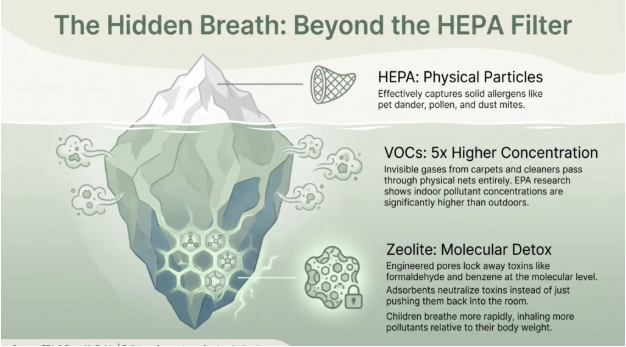
High-Efficiency Particulate Air (HEPA) filters are widely recognized as the gold standard for trapping solid physical particles. They are incredibly effective at capturing pet dander, seasonal pollen, and large dust mites that trigger traditional sniffles and sneezing.
However, HEPA filters are essentially very fine physical nets; they cannot catch gases, odors, or chemical vapors. If your home has high humidity or is heavily polluted with VOCs from a recent nursery painting project, a basic HEPA filter will simply push these gaseous pollutants right back into your child’s breathing zone.
The Science of Trapping Gases and Moisture
To completely purify an indoor environment, advanced systems utilize complex chemical engineering rather than relying solely on physical nets. While standard carbon filters do a decent job of masking odors, the most effective modern air purification and dehumidification systems rely on commercial-grade adsorbents.
For instance, reputable molecular sieve manufacturers like Jalon engineer specialized synthetic zeolite powders designed to trap microscopic toxins, VOCs, and excess moisture directly at the molecular level. These advanced materials act like microscopic sponges with perfectly sized pores that lock away harmful gases so they cannot re-enter the air.
Understanding these commercial filtration benchmarks helps parents make informed choices when investing in appliances that actually neutralize airborne toxins rather than simply recirculating them. Upgrading to advanced filtration guarantees a deeper, safer clean.
Everyday Habits to Keep Your Home’s Air Clean
Upgrading your home’s filtration technology is highly effective, but it should be paired with daily, proactive lifestyle changes. Reducing the source of pollution is always the safest and most economical way to protect your family from indoor toxins.
- Open Windows Strategically: Practice “cross-ventilation” by opening windows on opposite sides of the house for at least 15 minutes a day. Do this early in the morning or late in the evening when outdoor pollen and urban smog levels are lowest.
- Switch to Low-VOC Products: When painting walls, sealing floors, or buying new cribs, actively look for “Low-VOC” or “Zero-VOC” certifications to prevent long-term chemical off-gassing in the nursery.
- Manage Indoor Humidity: Keep indoor humidity levels tightly controlled between 30% and 50% to prevent the growth of mold and dust mites. Always use exhaust fans in bathrooms and kitchens to vent damp steam outside.
- Ditch Synthetic Fragrances: Swap out chemical plug-in air fresheners, synthetic seasonal candles, and heavily scented laundry detergents for natural essential oils or simple baking soda deodorizers.
- Vacuum with a Sealed System: Ensure your vacuum cleaner utilizes a fully sealed HEPA system. This ensures the ultra-fine dust and settled chemicals you suck up stay trapped, rather than exhausting back into the room.
By integrating these simple, cost-effective habits into your weekly routine, you drastically reduce the chemical burden placed on your home’s air purification systems. It requires minimal daily effort but yields massive, noticeable improvements in air freshness.
Key Takeaways
| Area | Key Takeaway | Impact/Data |
| Risk | Airtight homes trap off-gassing VOCs | Pollution 2-5x higher than outdoors |
| Hardware | Standard HEPA ignores chemical vapors | Toxins re-enter breathing zones |
| Tech | Deploy molecular sieves (zeolites) | Permanently locks away microscopic gases |
| Ops | Enforce 30-50% humidity & cross-ventilation | Halts mold and dust mites |
The Long-Term Impact on Your Children’s Respiratory Health
The effort to detoxify your home’s air pays massive dividends for your family’s overall well-being, particularly for vulnerable infants and toddlers. Because children breathe more rapidly than adults, they inhale a proportionally larger dose of indoor pollutants relative to their small body weight.
According to comprehensive research on indoor air quality published by the Environmental Protection Agency (EPA), indoor levels of pollutants may be two to five times higher than outdoor levels. This alarming concentration directly contributes to the rising rates of childhood asthma, chronic congestion, and persistent skin conditions like eczema.
By eliminating harmful VOCs, controlling excess moisture, and upgrading your filtration strategies, you actively reduce the daily inflammation in your child’s airways. You aren’t just creating a home that smells cleaner; you are building a safe sanctuary that actively supports their developing immune system.
Ultimately, taking control of your indoor air quality is one of the most proactive, impactful investments you can make in your child’s long-term health. Clean air is not a luxury—it is a fundamental building block of a healthy home.
Leave A Reply!