Explore effective ways to deal with anxiety while driving and regain control over your emotions behind the wheel.
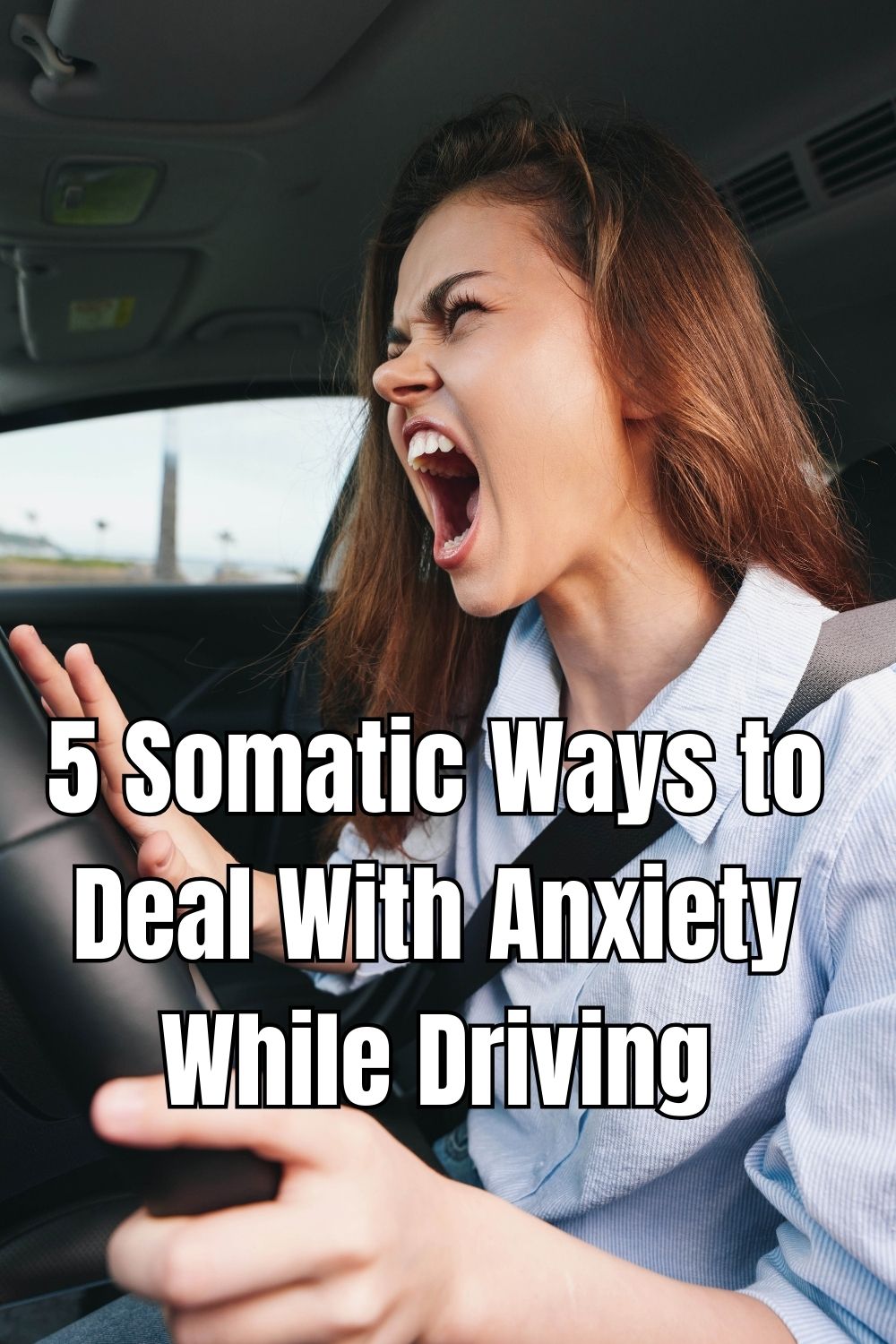
5 Somatic Ways to Deal With Anxiety While Driving
Do you find yourself being all anxious and stressed while behind the wheel? Like, most of the time? Well, the good news is that there’s nothing wrong with you, and you’re DEFINITELY not alone here.
The other news is that you can definitely also do something about it.
If your hand shakes as you are reaching for your keys, or your chest tightens when you hear a sudden brake, your body is literally trying to shield you.
Here are 5 somatic tactics to move you from incessant survival mode back into a state of presence.
The ‘Peripheral Softening’ Method
Our vision naturally narrows when we’re anxious. This is basically our caveman brain helping us focus/concentrate on the threat.
Sure, there might not be an ACTUAL threat out there. But your brain doesn’t know that. And the fact remains that this ‘tunnel vision’ boosts our stress hormones and we’re left dealing with that anyway we know how.
Before you back out of the driveway, take a few seconds to soften your gaze, and relax your shoulder muscles…shake it off like Taylor Swift says. When you begin to pull out, try to see things in your peripheral vision without moving your head around anxiously.
By deliberately tapping into your peripheral vision, you signal your brain’s ventral vagal complex that the environment is indeed safe to scan, rather than a land replete with hidden predators.
Do the ‘Jaw-Shoulder Drop’ At Every Red Light
Trauma survivors tend to carry ‘armor’ in their upper bodies.
While driving, this is heard as shoulders creeping toward the ears and a clenched jaw. Because the trigeminal nerve (the part that controls the jaw) is connected to the emotional center of the brain, a tight jaw actually keeps your brain on high alert.
As a somatic reset, do every red light regularly:
- Take a long breath (slowly \till your lungs are filled completely) and shrug your shoulders to your ears (hold that position for a couple of seconds).
- Exhale sharply through your mouth, relaxing your shoulders, letting them drop completely.
- Gently wiggle your jaw from side to side for a couple of seconds.
Establish a ‘Grounding Seat’
Dissociation, the sensation to feel ‘spaced out’, detached from one’s body, is a usual reaction to road-related PTSD.
To combat this, you have to enlist your sense of touch. Press your feet into the floor mat firmly before starting the engine. Feel your sit-bones touching the chair.
In your head, name three textures you can feel:
- The leather of the steering wheel.
- The rough strap of the seat belt.
- The air is coming out of the air vent.
This ‘tactile anchoring’ averts the mind from drifting off into ‘what-if’ scenarios.
Managing the Logistical and Emotional Aftermath
A road accident rarely follows a straight line toward healing, in large part because the ‘event’ doesn’t end when the cars do.
Secondary trauma associated with insurance, repairs, and legal liability can keep your nervous system racing to the breaking point for months. Even if everything is ok, it’s your subconscious knowing all these things that’s keeping you on the edge.
Even without you realizing it, your subconscious might be running simulations about you getting in an accident and then having to deal with all that, with the medical treatment, the high cost of healthcare in the U.S., do you have insurance, what about all the legal side of things, will you crash, ‘oh no, you have to brake!’ – it’s things like that that drain you mentally (and physically) without you realizing it.
Here’s a quick example of this:
Just think about the fact that if you’re driving in Chicago and you end up in an accident. Based on Chicago traffic laws (Illinois), where you’ve got modified comparative negligence, you can recover damages only if you’re 50% or less at fault. This is super stressful because no one’s really planning on getting into an accident.
So when one happens, is it your fault, or the other person’s? How do you determine the percentage? It’s chaos. You need a super-skilled lawyer, which again can cost you money.
It’s pure stress.
If the accident happens in San Francisco (California is also an at-fault state), it has pure comparative negligence, which means that even if you’re 99% at fault, you can still recover some damages.
Sure, they’ll be reduced based on your fault percentage, but it’s so much less stressful because you know you’ll get (most likely) at least something.
The ‘Voo’ Breathing Technique to reset the Vagus Nerve
To help in your wellness journey, embrace all techniques that progress your journey to healing.
Developed by the somatic pioneer Peter Levine, the so-called Voo sound is one of the most potent ways to vibrate the chest and diaphragm and help stimulate the vagus nerve so as to help the body relax. While driving (especially if you’re feeling a flare of panic), take a full breath in and, on the exhale, make a deep, low vibration, a Voooooo sound.
The vibration assists with ‘shaking out’ the tension on the sympathetic nervous system.
It’s a nice, handy way of getting rid of all that ‘freeze’ energy that builds up during those busy commutes.
Conclusion
If you find yourself feeling anxious while you’re driving, that doesn’t mean that there’s something inherently wrong with you. It’s your body protecting you. Sure, you might not be in danger. But your body doesn’t know that, and sometimes it’s a bit overprotective, leading to you feeling anxious for no apparent reason.
But what you can do is let your body know that everything’s ok. Use breathing techniques and/or muscle relaxation to send signals to your brain that you’re safe, and there’s no need to worry.
And the more you do it, you’ll train your body to know you’re ACTUALLY safe without you having to communicate back to it.
Long story short: anxiety is your body’s protective mechanism, and you can retrain your brain/body not to activate it all the time.
Leave A Reply!